Renewable energy development is expanding into more rural counties, and many landowners are being approached about hosting solar projects on their properties. If you’re evaluating an offer or seeing development move into your county, you may hear one of these terms: agrisolar and conservation solar. Both describe solar built with agricultural and ecological goals in mind, but they take different approaches with different practices, design priorities and implications for what your land looks like during and after the lease.
Here’s what each one actually means, the practices behind them and why both have a role to play as more electricity is generated from solar on farmland and ranchland.
What Is Agrisolar?
Agrisolar—sometimes called agrivoltaics—is the co-location of active agricultural production (crops, livestock or bees) with solar energy generation on the same acreage. Rather than treating solar and farming as competing uses of the land, agrisolar is designed from the start to let both happen at once. It typically takes one of three forms:
- Crop Cultivation: This means growing crops underneath or between rows of panels, sometimes with wider row spacing and taller racking built in for light, water and equipment access. Research has found that the shade and moderated microclimate under panels can even reduce plant stress and improve water use efficiency for some crops.
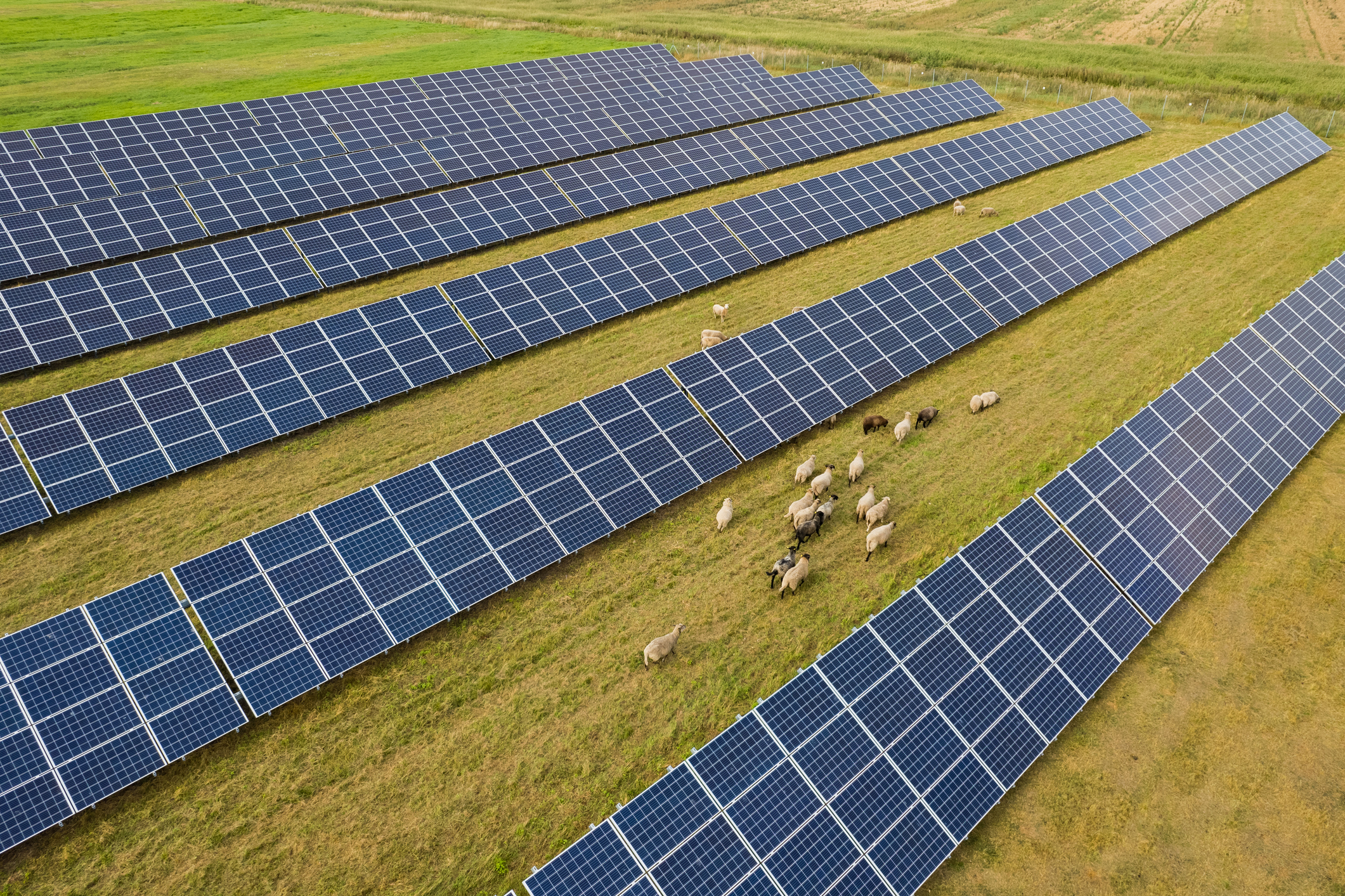
- Livestock Grazing (Solar Grazing): Sheep are the most common grazing animal on solar sites because their size lets them move comfortably beneath standard racking and they clear vegetation that would otherwise require mowing crews to squeeze between rows. According to the American Solar Grazing Association (ASGA), roughly 113,000 sheep were grazing 129,000 acres across more than 500 solar sites as of October 2024. The solar owner typically pays a local sheep farmer to graze a site to manage the vegetation, reducing or eliminating mowing and giving the farmer new pasture and income in return. Cattle grazing on solar sites, sometimes called cattlevoltaics, is less common but emerging in some regions.
- Apiaries: Beekeeping operations can also be sited alongside a solar array. The USDA’s Natural Resources Conservation Service classifies honeybees as domesticated livestock, and solar apiaries pair naturally with the pollinator-friendly seed mixes many sites already plant.
The Benefits of Agrisolar
With agrisolar practices, the farmland produces electricity and stays in agriculture; farmers gain a second, often more predictable income stream, and well-managed grazing or cropping brings real soil and water benefits along the way.
But agrisolar considerations are best made at the beginning of planning a solar site. Panel height, row spacing, fencing, water access and equipment placement need to be worked out at the design stage. Retrofitting a standard array afterward is more difficult than building those needs into the lease up front.
What Is Conservation Solar?
Conservation solar starts from a different place. Instead of centering active farming or ranching on the site, it applies natural resource conservation principles to how a utility-scale solar farm is sited, built and managed. The goal is to minimize the project’s environmental footprint while advancing conservation objectives, like protecting water quality or building soil health. Ideally the site and surrounding landscape are left in better ecological shape than before.
The USDA NRCS points to several core practices:
- Limiting grading and equipment traffic to protect soil
- Planting native, low-growing, pollinator-friendly vegetation instead of turfgrass
- Designing for landscape connectivity through wildlife-permeable fencing and site layouts that preserve movement corridors for game species and other wildlife
- Favoring driven-post or ballasted racking over poured concrete so the land can more easily return to agricultural use later
- Planning for fire and disturbance through mowing, grazing and firebreaks
Because a solar site sits within a larger landscape, well-managed conservation solar can deliver benefits that reach beyond the fenceline and support pollinators, water quality and wildlife movement in the surrounding area. Research on solar-wildlife interactions describes utility-scale solar facilities as functioning like ecosystems in their own right. Both the site and the surrounding landscape shape outcomes for wildlife movement, habitat connectivity and adjacent ecological function.
On sites with suitable habitats, researchers have documented pollinators foraging and reproducing in solar-pollinator habitats, birds nesting and perching in and around array infrastructure and small- and medium-sized mammals using vegetated sites for cover and foraging. When a species breeds or forages successfully on-site, the resulting offspring, forage resources and pollination services can extend outward into the surrounding landscape, contributing to populations well beyond the project boundary.
The Benefits of Conservation Solar
By applying conservation solar practices, sites experience:
- Less environmental disruption during construction, operation and eventual decommissioning
- Stronger ecosystem services like pollination, erosion control, water filtration and greater biodiversity on-site and in the surrounding area
- Long-term soil health improvements that will benefit traditional farming or ranching down the road
The NRCS guidance draws on the agency’s broader conservation practice standards, which offer regionally adapted practices tailored to a site’s specific soil, water and wildlife concerns. Local soil and water conservation districts and extension agents can also be valuable partners. They often have a deep knowledge of your region’s conservation priorities and can help shape the site design and ongoing stewardship of the land. If a developer says a project follows NRCS guidance or involves a local conservation partner, ask to see how that shows up in the actual site plan.
Why Both Matter for Sustainable Solar Development
Agrisolar and conservation solar aren’t competing frameworks, and the strongest projects often draw on both. A solar grazing operation is agrisolar at its core, but it’s also a conservation practice that manages vegetation with little to no mowing or herbicide use and can be layered with pollinator plantings to advance conservation and agricultural production objectives together.
A recent article in the Journal of Sustainable Agriculture and Environment makes this case directly: rather than treating solar as a threat to agricultural land, the authors argue that thoughtfully designed solar can help build resilience in rural communities. That can look like restoring degraded ground, but the same principles apply on productive land too, offering small family farms a diversified income while helping keep soil and water quality part of the equation.
Getting there takes coordination between a lot of different parties: you know your soil, water and grazing capacity better than anyone showing up with a lease. Developers bring the engineering and financing. NRCS staff, extension agents and organizations like ASGA can help translate goals into a workable plan.
Local officials and communities have a stake too, since siting decisions shape the tax base and land use for decades. Policy is starting to reflect that, and several states now route solar production taxes and land-lease revenue back into local roads, schools and services, treating agricultural and ecological outcomes as part of the same conversation.
If you’re evaluating a lease offer, the takeaway is this: agrisolar and conservation practices aren’t mutually exclusive, and a well-negotiated lease can deliver both. But that only happens if grazing rights, crop access, vegetation standards and habitat goals are on the table from the start, not as an afterthought once construction is already underway.
You Don’t Have to Navigate This Alone
If you’re weighing your first solar offer or trying to figure out what “conservation-minded design” means in a lease you’ve already signed, REFA can help. REFA’s non-legal lease review services, delivered through our partnership with Pinion Global, focus on the business and agricultural terms that matter most to farmers and ranchers.