
By Jeff Risley, REFA Executive Director
I spent last week in San Antonio at the 80th Annual Meeting of the National Association of Conservation Districts. It was my first NACD meeting, and I went with a specific purpose: to meet the farmers and ranchers who serve on local conservation district boards and to explore how REFA might partner with these organizations. What I found exceeded my expectations.
A System Built for This Moment
Soil and Water Conservation Districts have been helping landowners protect their land for nearly 90 years. They exist because of one of America’s worst environmental disasters: The Dust Bowl.
In 1935, while dust clouds from the Plains passed over Washington, D.C., Congress passed the Soil Conservation Act. Two years later, President Roosevelt wrote to all state governors recommending legislation that would allow landowners to form conservation districts as governmental subdivisions of their states.
The system that emerged was built on three principles: local control, voluntary participation, and technical assistance rather than regulation. Today, nearly 3,000 conservation districts operate across the country, with more than 17,000 citizens serving on governing boards. Most of those board members are farmers and ranchers.
Learning from Conservation Partnerships
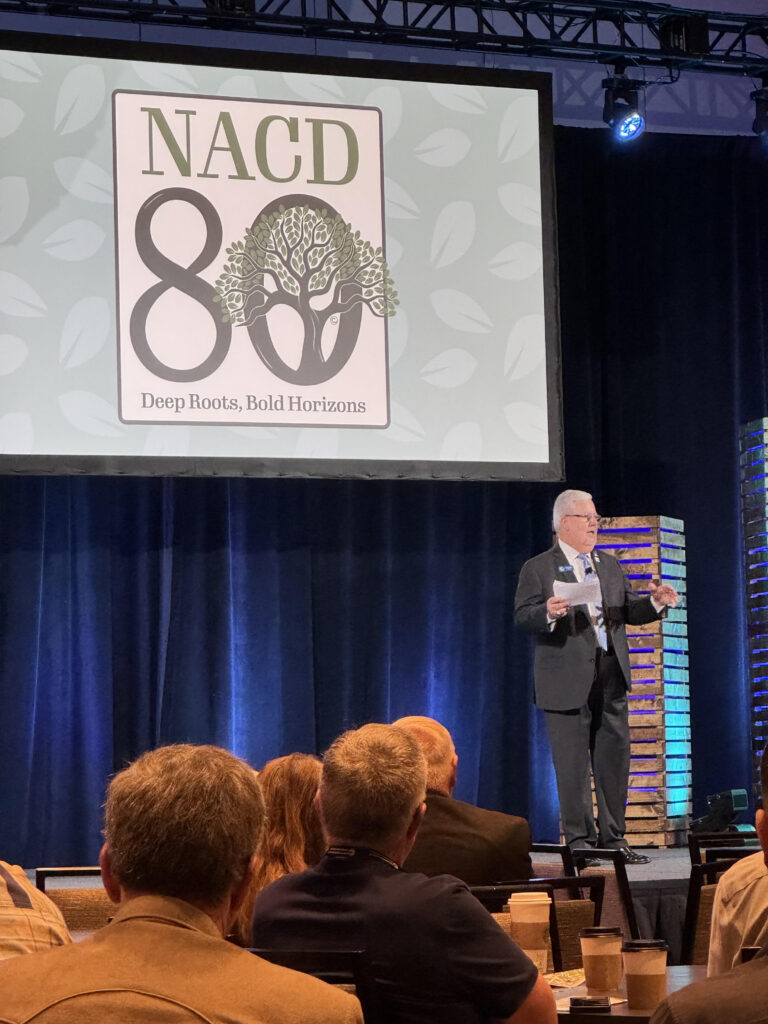
One session at the meeting stood out for me. “Shared Resources = Shared Vision” brought together speakers from across the conservation landscape: Candace Bergesch from Trust In Food at Farm Journal, Lauren Alleman from Ducks Unlimited, Ashley Gallagher from Dakota County Soil and Water Conservation District, and Margot Conover from General Mills.
The panel explored how successful conservation partnerships can be structured. What struck me was the diversity of partners working together: international consumer packaged goods companies, nonprofit conservation organizations, and local district staff. Each brought different resources and perspectives. Together, they were accomplishing things none could do alone.
The speakers shared real case studies and metrics from programs across the country. They discussed how to create momentum, unlock funding, and build outreach support.
I left that session thinking about REFA’s work and how it fits into this picture.
A Powerful Connection
Conservation districts have technical expertise directly relevant to renewable energy development:
- Soil health assessment for evaluating site suitability
- Erosion control during and after construction
- Stormwater management for solar sites
- Vegetation establishment, including native plantings and pollinator habitat
- Conservation planning that integrates energy projects with farm management goals
NRCS published Conservation Guidance for Utility-Scale Solar Projects in late 2024, identifying specific practices for protecting soil and water resources on solar sites. District staff have the expertise to implement these practices. The question is whether they’re being asked to help by landowners and/or developers.
Often most renewable energy conversations happen without SWCD involvement. Landowners sign leases without conservation input. Projects are designed without local soil and water expertise. Opportunities to protect land while hosting energy infrastructure get missed.
What REFA Is Building
At REFA, we’ve been developing resources to help bridge this gap. We recently completed two new briefs that address questions both landowners and conservation professionals need answered.
The first, “Can You Host Renewable Energy AND Keep Your NRCS Program Payments?” walks through how CRP, EQIP, CSP, and ACEP interact with different types of renewable energy infrastructure.
The second brief, “Prime Farmland in Federal Conservation Programs: Understanding the Data”, provides factual context for land-use discussions.
These briefs exist because landowners and local officials need reliable information. Conservation district staff can use them too.
The Opportunity Ahead
What I saw at NACD convinced me that conservation districts are natural partners for responsible renewable energy development.
SWCDs could provide technical assistance to landowners evaluating lease proposals, helping them understand erosion risks and conservation implications before they sign. They could offer model ordinance language to counties developing renewable energy standards. They could partner with developers on site design that protects soil and water resources from the start.
REFA brings the landowner perspective, renewable energy knowledge, and research resources. Conservation districts bring technical expertise, local relationships, and nearly 90 years of experience helping farmers and ranchers protect their land.
The farmers and ranchers I met in San Antonio care deeply about stewardship. They’ve spent careers helping neighbors implement conservation practices. Renewable energy is reshaping rural landscapes. Whether it happens in ways that protect soil and water resources depends partly on whether conservation expertise informs the process.
Learn More
REFA’s new briefs on NRCS programs and conservation program enrollment are available for download on our website. If you’re a landowner trying to understand how renewable energy fits with your conservation programs, or a district professional looking for resources to share, these are a good place to start.